Mayor Bass solicited companies with millions riding on City Hall decisions
Regional News

Audio By Carbonatix
6:30 AM on Tuesday, September 22
Adam Herbets
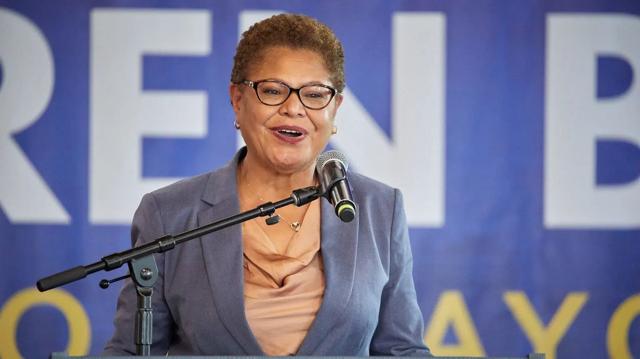
(The Center Square) - Los Angeles Mayor Karen Bass has prompted donors to spend $38 million on her favorite charities and third-party organizations, in some cases from donor companies who had hundreds of millions of dollars worth of business before the city.
On multiple occasions, she did not disclose the outstanding business on transparency forms as required by state law.
The vast majority of the money — approximately $33 million — went to organizations or funds closely connected to Bass or City Hall. She is seeking her second term as mayor in November against Councilwoman Nithya Raman.
Bass is on pace to raise more money from behested payments than any other elected official in city history, according to data from the Los Angeles City Ethics Commission and reviewed by The Center Square. She currently sits in second behind former Mayor Eric Garcetti. He asked donors for approximately $75 million over nine years.
California limits campaign contributions, but its behested-payment system allows elected officials to solicit unlimited sums of money from large corporations or special interest groups, so long as the money goes to a third party rather than to the politician’s personal account or campaign account.
Sean McMorris, who manages the transparency and ethics program for California Common Cause, said he was not surprised to see the types of donors Bass has been hitting up for money. But he was concerned to learn that she failed to disclose multimillion-dollar contract proceedings that were decided within days or weeks of some donations.
“The politicians know very well who to go to,” McMorris said. “They’re going to someone who they know needs something from them… This whole behested payment thing doesn't really work unless you can solicit people and entities who need things from you at the government level.”
After analyzing hundreds of payments made at Bass’ behest, The Center Square identified dozens of companies with city business at or around the time of donation. Bass disclosed the pending city business in only some cases. Our review found the same pattern across multiple industries, from telecommunications and banking to airlines, engineering and technology.
Bass has not responded to multiple requests for comment. Neither has Shery Yang, a spokeswoman for the California Fair Political Practices Commission (FPPC). The FPPC is the state ethics agency created by voters in 1974 in the wake of the Watergate scandal to shine light on political money. City officials said the FPPC would likely be responsible for investigating any failures by Bass to disclose.
Bass does not vote alongside the 15-member Los Angeles City Council, but the city gives its mayor substantial authority over city contracts through recommendations and approvals. She also appoints many of the department heads and commissioners involved in decisions.
The Center Square has focused its reporting on several of the most significant cases. The accompanying database includes dozens of additional examples of donors with city business and an outline of which cases Bass chose to disclose to the public.
Los Angeles Mayor Karen Bass solicited companies relying on city decisions
Bass asked AT&T for donations with $60M contract pending
AT&T’s slogan is “Connecting Changes Everything.”
As Los Angeles officials considered reupping a deal that would allow the city to spend up to $60 million with AT&T, the telecommunications company funded events organized by Bass, including a winter festival and a Pride celebration.
AT&T made four donations to the Getty House Foundation at the mayor’s behest from April 2023 through July 2025. Getty House Foundation is a nonprofit associated with the city-owned mansion where Bass lives.
Bass initially disclosed AT&T had “multiple contracts” with Los Angeles when the company made its first $10,000 payment to Getty House Foundation in April 2023 at the mayor’s behest.
But documents from the Los Angeles City Ethics Commission show Bass did not make that same disclosure on three subsequent AT&T payments, even though city records confirm AT&T had multiple contract proceedings with Los Angeles during that time frame.
"What do you think would have happened if Karen Bass reached out to AT&T three times and each time they said, 'No. We're going to pass on this?'" McMorris asked. “The amount of money is important, but not as important as the timing.”
The city continued approving multimillion-dollar AT&T contracts prior to its $10,000 payment to Getty House Foundation on July 18, 2025.
The president of Getty House Foundation’s board is Lupita Sanchez-Cornejo. She also serves as AT&T California’s regional vice president of external and legislative affairs. According to the foundation, Sanchez-Cornejo is responsible for AT&T’s “policy and stakeholder engagement strategy” in greater Los Angeles.
She has not responded to a request for comment. AT&T spokesman Kyle Loomis declined comment.
Banking on donations
Bass has sought donations from several banks while Los Angeles was approving or extending agreements for the banks to provide financial services to the city.
Wells Fargo made a $200,000 payment to the nonprofit California Community Foundation (CCF) at Bass’ request on Jan. 15, 2025 — the same day the City Council extended a city agreement with Wells Fargo worth approximately $5 million.
Ethics commission documents show Bass did not disclose Wells Fargo’s pending contract extension at the time. Wells Fargo has not responded to a request for comment.
Bass also steered the Bank of Montreal (BMO) to give tens of thousands of dollars to two nonprofits. Documents show Bass did not disclose any city business with BMO at the time of each payment despite one of the payments coming within three weeks of the bank receiving a three-year extension worth $1.7 million.
Scott Doll, a spokesman for BMO, declined an interview with The Center Square.
In late 2025, Bass approved a request allowing Los Angeles to pursue a new four-year agreement with U.S. Bank for fuel and fleet cards used by the city’s police, fire, and general services departments. The City Council followed the mayor’s recommendations and approved the agreement in December.
Approximately six months later, U.S. Bank made a $5,000 payment to the Pacific Asian Consortium in Employment at Bass’ request.
Bass did not disclose the city contract despite it being approved within 12 months of U.S. Bank’s donation, however she did disclose U.S. Bank contracts with the Port of Los Angeles in 2023.
Jeff Shelman, a spokesman for U.S. Bank, declined an interview request.
"Wouldn’t any contracts we have with the city be a public record?" Shelman asked in an email. "It wouldn’t be appropriate for us to speak on behalf of the mayor. That would be a better question for her or her team."
Amazon was primed to keep donating
Bass has prompted Amazon to donate six times to various nonprofits, totaling $232,217.
After Amazon’s first payment in May 2023, Bass disclosed the company held multiple contracts with the city at the time of payment. Bass has not explained why she did not disclose any of Amazon’s business with the city for any of the other five payments.
The city began migrating its tax-collection system to a cloud run by Amazon Web Services (AWS) in 2022, entering into a contract with Infosys that included AWS cloud infrastructure and support for an eventual $6.26 million. The migration was still underway when Bass got Amazon to make its first and second payments at her behest on May 17, 2023 and November 24, 2023. Both donations went to the Mayor’s Fund for Los Angeles, a nonprofit in which Bass serves as an “advisor” to the board.
City records show Los Angeles issued a $25,000 purchase order with AWS on December 24, 2024, just 31 days before Amazon gave a $7,217 donation to Community Coalition at the mayor’s behest. Community Coalition is a nonprofit that was founded by Bass prior to becoming mayor.
Although the AWS migration had been completed, the city’s relationship with Amazon continued with maintenance and support. Amazon continued making behested payments, including within seven days of a contract extension. Amazon has not responded to a request for comment.
HDR gave twice, contract disclosed once
Engineering giant HDR made two $5,000 payments to Getty House Foundation at Bass’ request as Los Angeles was approving a contract worth up to $138.5 million for the company to help manage a massive modernization project at Los Angeles International Airport (LAX). The city’s airport department selected HDR for a seven-year contract for roadway improvements at LAX.
The contract was still awaiting key city approvals when HDR made its first $5,000 payment at Bass’ request on March 11, 2023, but documents show Bass did not disclose any pending city business at the time of the payment. Less than three weeks earlier, the City Administrative Officer had sent Bass a report specifically recommending that she approve the HDR contract.
Bass eventually approved the recommendation, and the City Council unanimously voted in favor of the contract on April 25, 2023.
Just days later, HDR made another $5,000 payment to Getty House Foundation at Bass’ request. This time, documents show Bass checked the proceeding box on her disclosure and identified a city contract.
Lindsay Housner, a vice president of communication for HDR, said the company does not make "political or campaign contributions" in Los Angeles but otherwise declined to comment.
Millions up in the air at LAX
Alaska Airlines has had preferential use of gates and leased space in LAX's Terminal 6 due to a 2011 agreement with the city. The city approved up to $2.9 million in rent credits for Alaska Airlines in early 2024.
Later in 2024, Alaska Airlines had two matters pending before the Los Angeles government.
First, a trade organization representing Alaska Airlines wrote a letter to the City Council pushing back against a proposed LAX wage increase for workers. The letter warned the proposal could increase airline costs by approximately $1 billion over six years. Alaska Airlines spent tens of thousands of dollars that year on lobbying efforts.
The City Council ultimately moved forward with LAX wage increases at a softer pace than initially proposed on December 11, 2024.
Second, LAX was in the middle of a $231 million Terminal 6 modernization project being administered by Alaska Airlines. The city agreed to expand the project’s budget by $900,000 on December 12, 2024 due to Alaska Airline’s inability to meet deadlines.
Although Bass did not personally vote on the appropriation, it was voted on by an airport oversight board whose members are appointed by the mayor and can be removed by the mayor without City Council approval. Approximately 40 days later, Bass prompted Alaska Airlines to make a $100,000 payment to the Los Angeles Fire Department Foundation.
Records show Bass did not disclose the payment until three months later, which was approximately 60 days late pursuant to state law. She has not been fined. Bass also failed to disclose any of Alaska Airline’s business with the city at the time of her solicitation for money.
Alaska Airlines did not respond to a request for comment.
Where California draws the line
California’s FPPC does not prohibit government officials from soliciting money from companies even when they have pending government business, so long as the proceeding is properly disclosed to the public and there is no evidence of a quid pro quo.
“The problem is, we don’t know (if there’s a quid pro quo),” McMorris said. “They’re always going to say these payments never influenced it, but at the end of the day we don’t know that… Whether it’s legal or not, in the eyes of the people, it is a conflict of interest. Most people are going to perceive it that way.”
Some in Los Angeles have already tried and failed to implement stricter laws that would have banned politicians from soliciting money from “restricted sources,” including lobbyists, city contractors, or bidders hoping to be paid with taxpayer dollars via the government.
Unlike Los Angeles, San Francisco prohibits behested payments from “interested parties” with government business, although the San Francisco Board of Supervisors can grant waivers.